HRV and Sleep: What Your Heart Rate Variability Actually Tells You
Heart rate variability (HRV) reflects your nervous system's recovery state and correlates with sleep quality. Higher HRV typically indicates better recovery, but individual baselines matter more than absolute numbers.
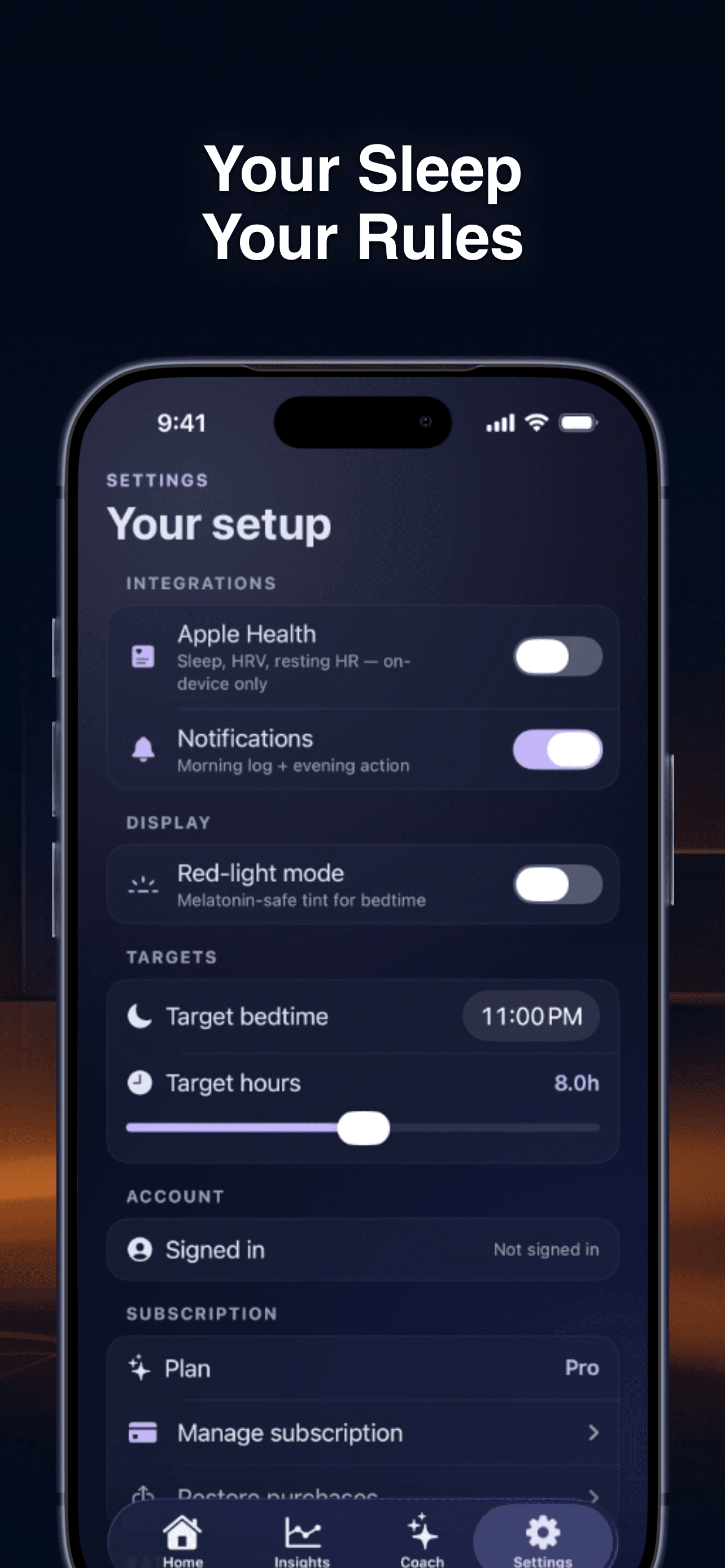
Photo by Sleep Arc.
Your Apple Watch tracks a metric called HRV every night. Most sleep apps display it as a number between 20 and 60. But what does heart rate variability actually mean for your sleep quality?
HRV measures the tiny variations in time between your heartbeats. When your parasympathetic nervous system is active—the "rest and digest" mode—these variations increase. When you're stressed or poorly recovered, the variations decrease. Higher HRV generally indicates better recovery and sleep readiness.
The relationship between HRV and sleep isn't straightforward. Your HRV doesn't predict how well you'll sleep tonight. Instead, it reflects how well you recovered from yesterday.
What HRV Measures During Sleep
Heart rate variability tracks your autonomic nervous system's balance throughout the night. Your Apple Watch calculates HRV using RMSSD—the root mean square of successive differences between heartbeats.
During deep sleep, your HRV typically increases as your parasympathetic nervous system takes control. During REM sleep, HRV often decreases as your sympathetic nervous system becomes more active. This pattern is normal and healthy.
Your morning HRV reading represents an average across the night, weighted toward your deepest sleep periods. A higher reading suggests your nervous system spent more time in recovery mode.
How HRV Correlates with Sleep Quality
Research shows moderate correlations between HRV and subjective sleep quality, but individual patterns matter more than population averages. Your personal HRV baseline—established over weeks of tracking—is more predictive than any single night's reading.
I've tracked both metrics for six months. My HRV ranges from 28 to 52 milliseconds. When it drops below 32, I usually feel less rested, even if my sleep duration was adequate. When it's above 45, I typically wake feeling recovered.
Three factors influence this relationship:
- Stress levels: Chronic stress suppresses HRV even after good sleep
- Training load: Overtraining reduces HRV regardless of sleep duration
- Alcohol consumption: Even small amounts lower next-day HRV
The key insight: HRV reflects your body's recovery capacity, not just sleep quality.
What Your HRV Numbers Actually Mean
Most healthy adults show HRV readings between 20-60 milliseconds. But your individual range matters more than hitting any specific target.
Interpreting Your Personal Range
Track your HRV for at least two weeks to establish your baseline. Look for these patterns:
- Green zone: Upper 25% of your personal range indicates good recovery
- Yellow zone: Middle 50% suggests normal variation
- Red zone: Lower 25% may indicate incomplete recovery
Age affects HRV significantly. Younger adults typically show higher variability, with averages declining by roughly 1 millisecond per year after age 30.
Gender also plays a role. Women often show higher HRV during the follicular phase of their menstrual cycle, with lower readings during the luteal phase.
When HRV Trends Matter More Than Single Readings
Daily HRV fluctuates naturally. A single low reading doesn't indicate poor sleep or health problems. Instead, watch for sustained trends over 5-7 days.
Declining HRV trends often precede illness symptoms by 1-2 days. This makes HRV useful for adjusting training intensity or prioritizing recovery before you feel sick.
How Sleep Arc Uses HRV Data
Sleep Arc integrates with Apple Health to incorporate your HRV alongside sleep duration, bedtime consistency, and subjective quality ratings. The AI coach considers all these factors when recommending tonight's action.
Unlike apps that simply display your HRV number, Sleep Arc contextualizes it within your broader sleep patterns. If your HRV is low but you slept well subjectively, the coach might recommend gentle recovery activities rather than aggressive sleep interventions.
The app's one-action approach prevents HRV obsession—a common problem with detailed biometric tracking. Instead of overwhelming you with data, you get one concrete recommendation that considers your recovery state.
Limitations of HRV for Sleep Tracking
HRV provides valuable recovery insights but has important limitations for sleep assessment.
Measurement accuracy varies by device. Apple Watch HRV readings show good correlation with medical-grade equipment but aren't perfectly precise. Day-to-day variations under 10 milliseconds may reflect measurement noise rather than physiological changes.
Individual differences are enormous. Some healthy people consistently show HRV readings below 25, while others regularly exceed 60. Comparing your numbers to population averages provides little useful information.
HRV responds to many non-sleep factors. Caffeine intake, meal timing, room temperature, and even your sleeping position can influence readings. A low HRV doesn't automatically indicate poor sleep quality.
Practical Tips for Using HRV
Focus on trends rather than individual readings. Track your HRV for at least a month to understand your personal patterns.
Use HRV as one input among many. Combine it with subjective sleep quality, morning energy levels, and daytime performance to get a complete picture.
Don't chase higher numbers. Some people naturally have lower HRV but excellent recovery. Your goal is consistency within your personal range, not hitting arbitrary targets.
Consider HRV when planning demanding activities. If your HRV is consistently low, prioritize sleep optimization over intense workouts or stressful commitments.
The Bottom Line on HRV and Sleep
HRV reflects your nervous system's recovery state and correlates moderately with sleep quality. Higher readings generally indicate better recovery, but your personal baseline matters more than absolute numbers.
Track HRV trends over weeks, not individual nights. Use it alongside other sleep metrics to understand your recovery patterns. Don't let HRV data override how you actually feel.
Sleep Arc's approach to HRV integration exemplifies this balanced perspective—using the data to inform recommendations without creating metric obsession.
Frequently asked questions
- What is a good HRV score for sleep?
- There's no universal 'good' HRV score. Healthy adults typically range from 20-60 milliseconds, but your personal baseline matters more. Focus on staying within your upper 50% range rather than hitting specific numbers.
- Does higher HRV mean better sleep quality?
- Higher HRV generally indicates better nervous system recovery, but it reflects yesterday's recovery rather than predicting tonight's sleep quality. Individual patterns and trends matter more than single readings.
- How accurate is Apple Watch HRV for sleep tracking?
- Apple Watch HRV shows good correlation with medical equipment but isn't perfectly precise. Day-to-day variations under 10 milliseconds may be measurement noise. Focus on weekly trends rather than daily fluctuations.
- Why is my HRV low even after good sleep?
- HRV responds to stress, training load, alcohol, illness, and other factors beyond sleep quality. Low HRV with good sleep may indicate your body is managing other stressors or recovering from previous demands.
- Should I change my sleep routine based on HRV?
- Use HRV as one factor among many, including how you feel and your sleep quality ratings. Consistently low HRV trends may suggest prioritizing recovery, but don't make major changes based on single readings.