HRV and Sleep: What Your Heart Rate Variability Actually Tells You About Recovery
Heart rate variability (HRV) measures your nervous system's recovery status. Higher HRV typically indicates better sleep quality and readiness, but individual patterns matter more than absolute numbers.
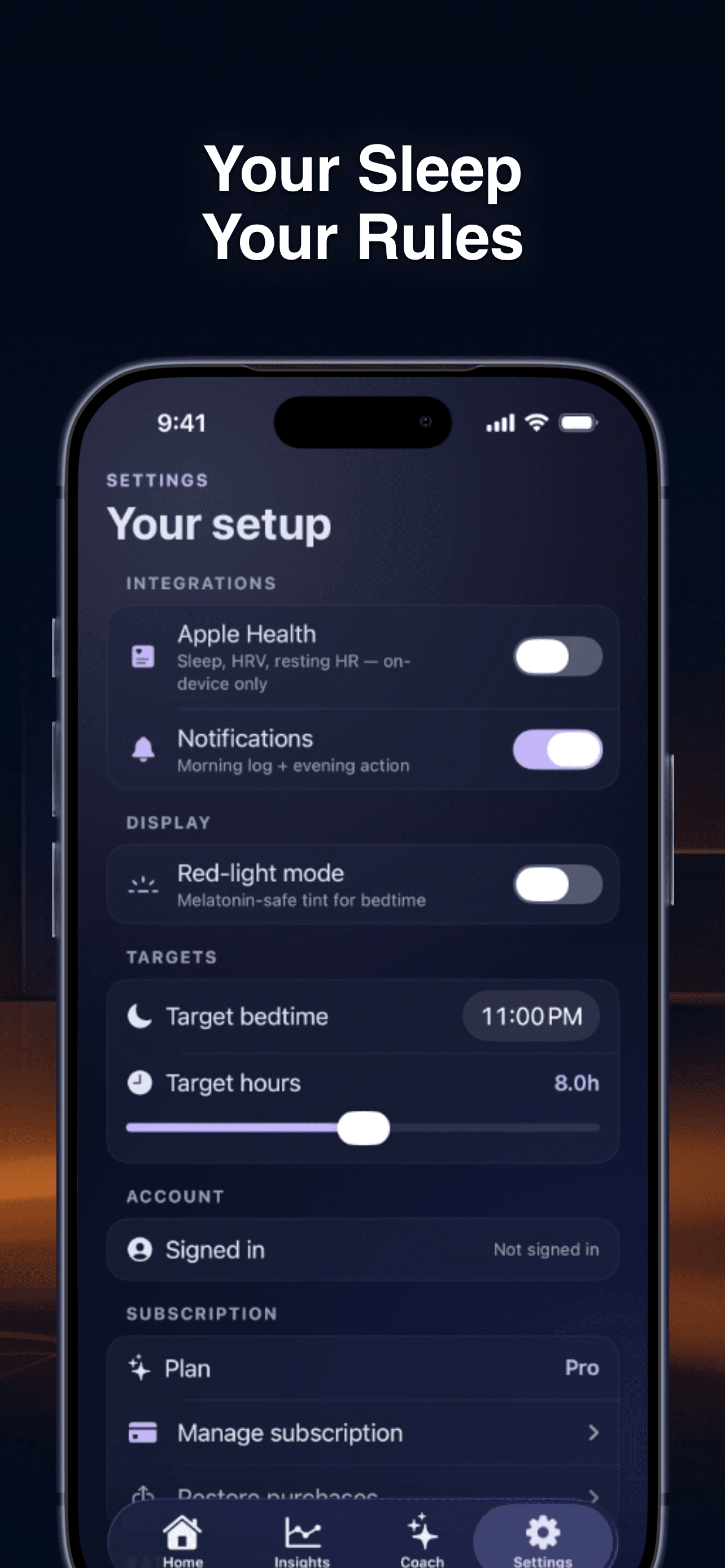
Photo by Sleep Arc.
Your Apple Watch measures heart rate variability every night. Most sleep apps display it as a number or trend. But what does HRV actually tell you about your sleep quality and recovery?
HRV measures the variation in time between heartbeats, reflecting your autonomic nervous system's balance between stress and recovery modes. Higher HRV generally indicates your body is in a recovery state, while consistently low HRV suggests accumulated stress or poor sleep quality. However, your personal baseline matters more than comparing to others.
I've been tracking HRV alongside sleep data for eighteen months. The correlation isn't always obvious night-to-night, but patterns emerge over weeks that reveal how sleep choices affect recovery.
What HRV Measures During Sleep
Heart rate variability reflects your parasympathetic nervous system activity. During quality sleep, your body shifts into recovery mode. Your heart rate slows and becomes more variable as your nervous system cycles through different states.
The measurement itself is straightforward. Your watch detects tiny variations in the time between heartbeats. Instead of a perfectly steady 60 beats per minute, healthy hearts show natural variation: maybe 0.95 seconds, then 1.02 seconds, then 0.98 seconds between beats.
Higher variability indicates your nervous system can flexibly respond to different demands. Lower variability suggests your system is stuck in a more rigid, stress-oriented state.
During sleep, several factors influence HRV:
- Sleep stage transitions: HRV typically increases during deep sleep phases
- Recovery processes: Physical and mental recovery both boost HRV
- Stress hormones: Elevated cortisol from poor sleep suppresses HRV
- Temperature regulation: Your body's cooling process affects heart rhythm patterns
How Sleep Quality Affects Your HRV
Poor sleep consistently drives down HRV, but the relationship works both ways. Low HRV can predict you'll feel unrested even after adequate sleep hours.
Research shows several sleep factors directly impact next-day HRV readings:
Sleep duration matters, but not linearly. Getting 7-8 hours typically optimizes HRV. Less than 6 hours consistently lowers it. But sleeping 9+ hours doesn't necessarily increase HRV further and sometimes decreases it.
Sleep timing affects HRV more than most people expect. Going to bed at your natural circadian preference (whether you're naturally early or late) produces higher HRV than forcing an unnatural schedule, even with identical sleep duration.
Alcohol significantly suppresses HRV. Even one drink within 3 hours of bedtime can reduce HRV by 15-25% that night. The effect often persists into the following night.
Room temperature impacts HRV through sleep quality. Temperatures above 70°F (21°C) or below 60°F (15°C) tend to reduce HRV by fragmenting sleep stages.
Reading Your Personal HRV Patterns
Your baseline HRV depends on age, fitness level, and genetics. A 25-year-old athlete might average 50-80ms, while a 45-year-old office worker might average 25-40ms. Both can have excellent recovery if their numbers are consistent within their range.
Focus on these patterns instead of absolute numbers:
Weekly trends matter more than daily fluctuations. A single low HRV night might reflect temporary stress, late caffeine, or measurement error. But three consecutive nights of declining HRV suggests accumulated sleep debt or lifestyle factors affecting recovery.
Baseline shifts indicate adaptation. If your average HRV increases over 2-3 weeks, your sleep habits are likely improving recovery capacity. Gradual decreases over similar timeframes suggest something needs adjustment.
Recovery patterns reveal sleep effectiveness. High-quality sleep typically produces HRV recovery within 1-2 nights after stress or poor sleep. If HRV stays suppressed for 3+ nights after returning to good sleep habits, your sleep might not be as restorative as it feels.
What Low HRV Really Means
Consistently low HRV relative to your baseline indicates your nervous system is stuck in sympathetic (stress) mode rather than parasympathetic (recovery) mode during sleep.
Common causes include:
- Insufficient deep sleep: Even with adequate total sleep time
- Late-evening stimulation: Screens, intense conversations, or exercise within 2 hours of bedtime
- Unresolved stress: Work anxiety or relationship tension that follows you to bed
- Poor sleep environment: Light, noise, or temperature disrupting sleep stages
- Timing misalignment: Sleeping significantly outside your natural circadian window
The key insight: low HRV often reflects sleep that looks adequate on paper but isn't providing genuine recovery. You might get 8 hours but wake feeling unrested because your nervous system never fully shifted into recovery mode.
Using HRV to Optimize Tonight's Sleep
HRV data becomes actionable when you connect it to specific sleep decisions. Track which factors correlate with your higher HRV nights, then adjust accordingly.
If your HRV is consistently low:
- Move bedtime 30 minutes earlier for one week
- Eliminate screens 90 minutes before sleep
- Keep your bedroom temperature between 65-68°F (18-20°C)
- Avoid caffeine after 2 PM
- Try a 10-minute meditation or breathing exercise before bed
If your HRV fluctuates unpredictably:
- Look for patterns around alcohol consumption, meal timing, or exercise schedule
- Check if stress levels correlate with low HRV nights
- Consider whether your bedtime varies too much between weekdays and weekends
If your HRV is stable but you want improvement:
- Focus on sleep consistency rather than duration
- Experiment with earlier bedtimes in 15-minute increments
- Add brief morning sunlight exposure to strengthen circadian rhythms
The most effective approach combines HRV trends with subjective sleep quality. Some nights you'll feel great despite lower HRV, and others you'll feel tired despite normal numbers. Your body's feedback remains the ultimate guide.
Sleep Arc integrates HRV data from Apple Health to provide personalized coaching based on your recovery patterns. Instead of generic advice, you get specific actions tailored to what your HRV trends reveal about your sleep quality and recovery needs.
Frequently asked questions
- What is a good HRV score for sleep recovery?
- There's no universal 'good' HRV score. Your personal baseline matters more than absolute numbers. Focus on maintaining consistency within your range and watching for upward trends over 2-3 weeks, which indicate improving recovery.
- How quickly does poor sleep affect HRV?
- HRV typically drops within one night of poor sleep quality. However, single nights of low HRV are normal. Look for patterns over 3+ consecutive nights, which suggest accumulated sleep debt or lifestyle factors affecting recovery.
- Can I improve my HRV through better sleep habits?
- Yes, consistent sleep improvements often increase HRV over 2-4 weeks. Key factors include consistent bedtime, optimal room temperature (65-68°F), avoiding late caffeine and alcohol, and maintaining good sleep environment conditions.
- Why is my HRV low even after 8 hours of sleep?
- Low HRV despite adequate sleep duration often indicates poor sleep quality rather than insufficient quantity. Factors like room temperature, late-evening stimulation, stress, or sleeping outside your natural circadian window can prevent genuine recovery.
- Should I change my sleep schedule based on HRV readings?
- Use HRV as one data point alongside how you feel. If HRV is consistently low and you feel unrested, experiment with earlier bedtimes, better sleep environment, or reducing evening stimulation. Combine objective data with subjective sleep quality for best results.