Why Your Sleep Score Keeps Dropping (and the One Habit That Usually Fixes It)
If your sleep score looks great one night and tanks the next, you're not imagining it. Here's the single behavioral lever that moves the needle for most people — and how to spot it in your own data.
Most people who track sleep end up with the same frustration: the score moves, but they can't tell why. One night it's 86, the next it's 63, and the "tips" screen offers the same three suggestions it offered last week.
This article is the thing I wish someone had handed me in week one of tracking.
The score is a symptom, not the problem
Your sleep score — whether it comes from Sleep Arc, an Apple Watch, or a ring — is a weighted blend of duration, efficiency, timing consistency, and (if you wear something) heart-rate variability and resting heart rate. None of those inputs are under your direct control at 2 a.m. They're downstream of decisions you made eight, twelve, even sixteen hours earlier.
So when the score drops, the useful question isn't "what was my deep sleep percentage?" It's "what did I do yesterday that I don't usually do?"
The single lever that moves the needle for most people
If I could only look at one variable for the average person, I'd pick the time of your last caffeine intake — and I'd bet on that being the answer maybe 60% of the time.
Caffeine has a half-life of roughly five to six hours. That means a 3 p.m. coffee is still hitting your adenosine receptors at a meaningful level past 9 p.m. The result isn't usually "I can't fall asleep." It's a subtler version: you fall asleep fine, but your sleep is more fragmented, your HRV drops, and your score ends up ten points lower than it should be.
The tell: your bedtime looks normal in your log, but your score craters anyway. If that matches your pattern, push your coffee cutoff back by two hours for a week and watch the trend.
The other usual suspects
Caffeine is the biggest lever, but these are the ones I see most often after that:
- Alcohol after 7 p.m. It's sedating, so it helps you fall asleep — and then destroys the back half of your night. Expect a 10–15 point score hit for anything more than one drink.
- Screens past your wind-down target. Not "blue light is evil" — more like the content you consume at 11:30 p.m. is almost always more activating than restful.
- Inconsistent wake time. Sleeping in on weekends costs you on Monday. Your circadian system tracks the wake signal harder than the sleep signal.
- Late heavy meals. Eating within two hours of bed routinely drops HRV by 10–20% overnight.
You don't need to fix all of these. You need to find the one that matches your data and fix that one.
How to actually find your lever
Here's the method that works, whether you use Sleep Arc or a spreadsheet:
- Log your nights for at least 14 days. Bedtime, wake time, and tags — caffeine cutoff, alcohol, screens, exercise.
- Sort your nights into your five highest-scoring and your five lowest-scoring.
- Compare the tags. What's present in the bad nights and absent in the good ones? That's your lever.
This is roughly the pattern Sleep Arc's coach runs every morning. It's not complicated, but it's the difference between generic tips and a recommendation that actually applies to you.
One night is not a signal. Four in a row is.
Sleep pressure is self-correcting. If you have one rough night, your body will usually compensate by going deeper, faster the next night. Don't panic-optimize after a single bad score — you'll add stress and make tomorrow worse.
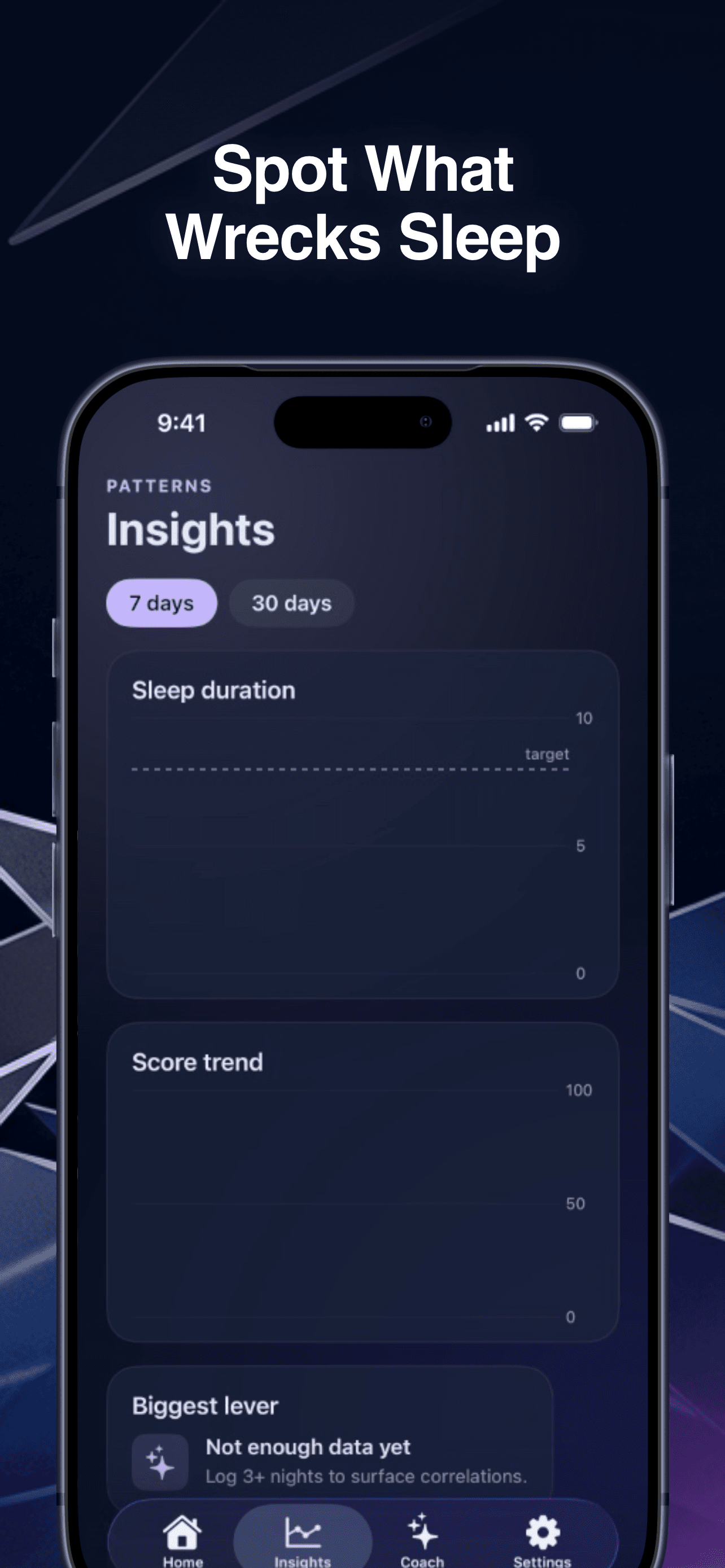
What matters is the 7-day average and whether it's trending up or down. Four bad nights in a row means something you're doing has changed. That's when you dig into the tags.
The habit that works for almost everyone
If you want one thing to try this week, try this: cut caffeine off at noon for seven days. Log nightly. Compare your 7-day average before and after.
It's the cheapest, fastest experiment in sleep, and for most people it moves the score five to twelve points. If it doesn't move for you, that's also useful — it means caffeine isn't your lever, and you can move on to alcohol or wake consistency.
The goal isn't perfection. It's finding the one lever that's yours.
Frequently asked questions
- What counts as a good sleep score?
- There is no universal cutoff — what matters is your own 7- and 30-day trend. A score that ticks up week-over-week is worth more than a single 90.
- Is one bad night a problem?
- No. Sleep pressure self-corrects within a night or two. Chronic drops — four or more nights in a row — are the signal worth acting on.